Shrija FinServ LLP (ARN-315260)
AMFI-Registered Mutual Fund Distributor
AMFI-Registered SIF Distributor
Shrija FinServ LLP (ARN-315260)
AMFI-Registered Mutual Fund Distributor
AMFI-Registered SIF Distributor
## This is important to know before you start.
Investing in mutual funds can be a part of your financial journey. Before investing, it is important to understand how mutual funds work, what risks they may have, and whether the investment aligns with your personal financial goals. This guide is designed for *educational and general purposes only*.
## 1. What is a Mutual Fund?
A mutual fund is an investment medium in which the money of many investors is collected and invested in various securities and assets. These investments, according to the objective of the scheme, may include equity, debt instruments, money market instruments or other permitted securities. Every mutual fund scheme has its own: * Investment Objective * Risk Level * Investment Strategy * Time Horizon. Therefore, it is important to understand the information related to the scheme carefully before investing.
## 2. Understand Your Financial Goals Before Investing
Before you start investing, ask yourself a few questions: * Why do I want to invest? * What is my financial goal? * What is my timeframe for this goal? * How much can I tolerate the fluctuations in the investment? * May I need this money early in the future?
Every person's financial situation, goals, and risk appetite may be different. Therefore, it is essential to understand any investment decision based on your personal circumstances.
## 3. Understand the relationship between risk and return
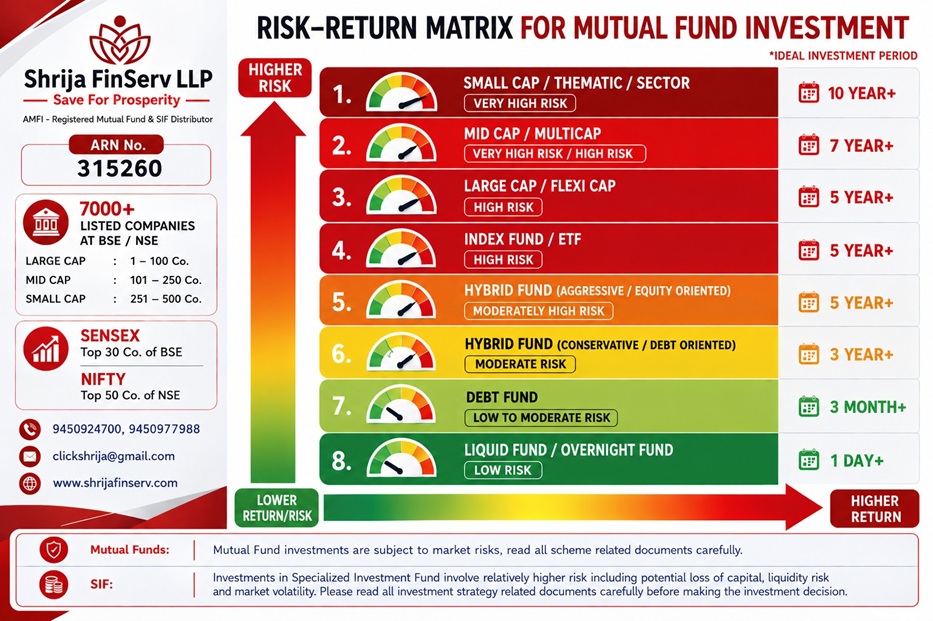
Generally, there is a relationship between potential returns and risk in investing. Some investment options may have higher price fluctuations, while others may have relatively lower price fluctuations. However, less or more risk does not mean a fixed or guaranteed return. In Mutual Fund Investment: * The value of the investment can increase or decrease. * Market conditions can be affected. * No returns are guaranteed. When investing, it is essential to understand both the potential returns and the potential risks.
## 4. Understand Equity, Debt, and Other Types of Mutual Funds
Mutual fund schemes can invest in different asset classes.
### Equity-Oriented Funds
Their investments can be mainly in equity and equity-related instruments. The impact of market volatility can be more in them.
### Debt-Oriented Funds
They can invest in debt and money market instruments. They can also have interest rate risk, credit risk, and other risks.
### Hybrid Funds
They can be a mix of different asset classes, including equity and debt.
The risks and investment objectives of each category and scheme may be different. It is important to read the relevant Scheme Information Document and other available documents carefully before investing.
## 5. Understanding SIP and Lump Sum Investment
Investing in mutual funds can be done in a variety of ways.
### SIP (Systematic Investment Plan)
Through SIP, the investor can choose to invest a fixed amount at regular intervals.
### Lump Sum Investment
In this, the investor invests a lump sum amount at a time.
Which method may be suitable depends on the investor's financial goals, cash flow, investment horizon, and personal circumstances. Returns are not guaranteed through SIP or any other investment instrument.
## 6. Why is Investment Horizon Important?
The timeframe for each financial goal may be different. For example: * Short-Term Goals * Medium-Term Goals * Long-Term Goals. Understanding your investment horizon can be useful when selecting an investment. It should not be considered advisable to choose any investment solely on the basis of past performance.
## 7. How to view past performance?
The past performance of a mutual fund scheme does not guarantee future performance. Rather than just looking at the returns before investing, it can also be important to understand aspects of the scheme such as: * Investment Objective * Risk Factors * Investment Strategy * Portfolio Characteristics * Expense Ratio * Investment Horizon.
## 8. Understand Riskometer
A riskometer can be a useful indicator for understanding the risk level of mutual fund schemes.
The riskometer helps the investor understand the risk level associated with the scheme. It is important to check the current riskometer and scheme documents of the concerned scheme before investing.
## 9. KYC & Important Information
Mutual fund investments may require necessary regulatory procedures to commence.
The investor should: * Complete the KYC process. * Provide correct and up-to-date information. * Must read the required documents and investment information carefully. Regulatory procedures may change from time to time.
## 10. Read Documents Before Investing
It is important to read the available scheme-related documents carefully before investing in any mutual fund scheme. These may include: * Scheme Information Document (SID) * Key Information Memorandum (KIM) * Statement of Additional Information (SAI) * Risk Factors * Other applicable documents
If there is difficulty in understanding any information, the investor should make a decision only after clearly understanding the relevant information.
## 11. Don't make investment decisions just by looking at returns
An investment decision should not be based solely on how much return it has given in the past. While making an investment decision, one can consider: * Your Financial Goal * Investment Horizon * Risk Appetite * Liquidity Requirement * Personal Financial Situation. It is not necessary that the same option is suitable for every investor.
## 12. Market Volatility is Normal
Financial markets can fluctuate. Short-term market movements can be influenced by many factors, such as: * Economic conditions * Interest rates * Inflation * Global events * Market sentiment. Instead of making hasty decisions based on market movements, investors should make informed decisions keeping in mind their financial goals and risk profile.
## 13. Review your investments periodically
Investors' financial goals and circumstances may change over time. Therefore, from time to time, your:
* Financial Goals
* Investment Horizon
* Risk Appetite
Reviewing Financial Requirements can be useful. However, investors need not change decisions with every market movement; what is suitable differs for each investor.
# A simple checklist for the new investor
Ask yourself before investing:
# Remember
Mutual Fund Investment is a financial decision and it is important to take it wisely. Before Investing:
*Understand your goals → know the risks → read the relevant documents → make informed decisions*
Knowledge and accurate information can aid in better understanding the process of investing.
## IMPORTANT DISCLAIMER
*Mutual Fund investments are subject to market risks, read all scheme related documents carefully.
*Past performance of the Scheme(s) is neither an indicator nor a guarantee of future performance.
Mutual Fund investments do not offer guaranteed or assured returns. The value of investments may go up or down depending on market conditions and other factors.
This material is for educational and general informational purposes only and should not be construed as investment advice, a recommendation, or an offer or solicitation to invest in any particular Mutual Fund Scheme, Asset Management Company (AMC), or investment product.
Investors should consider their individual financial goals, risk profile, investment horizon and other relevant factors before making an investment decision.
Click to read The Full Disclaimer & Statutory Information
At Shrija FinServ LLP, we are committed to helping individuals and businesses to navigate the world of financial products with trust and transparency. Our firm operates with a client-first approach, ensuring that every solution we offer aligns with your needs and goals.

Office no.17-18, 3rd Floor, Ashta Siddhi Trade Centre, Vijay Chowk, - Gorakhpur-273001 (U.P.)


